
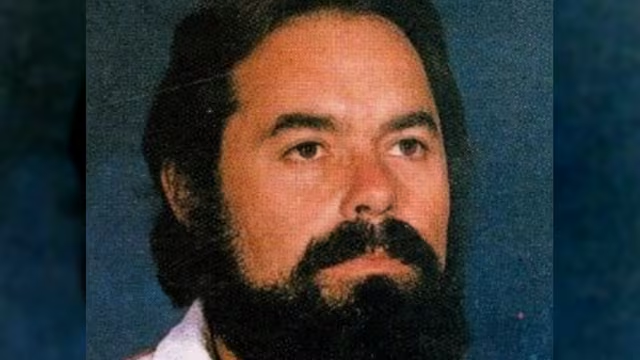
When Jacobo Grinberg-Zylberbaum stepped into his laboratory at Mexico’s National Autonomous University (UNAM) in the 1980s, he carried something most scientists left at the door: the willingness to ask impossible questions. This Mexican neurophysiologist and psychologist spent his career pursuing what others dismissed as pseudoscience—consciousness itself. What he found would challenge everything we thought we knew about the mind, reality, and the nature of existence.
Then, on December 8, 1994, on the eve of revealing his greatest discovery, he disappeared without a trace.
A Childhood Tragedy That Shaped a Visionary Mind
Born in Mexico City on December 12, 1946, Grinberg’s life was forever altered by a single, devastating event. At just twelve years old, he watched his mother die from a brain tumor. From that moment forward, his obsession with understanding the human mind became personal—and permanent. While other children moved on from childhood traumas, Grinberg channeled his grief into a singular purpose: to unlock the mysteries of consciousness itself.
This wasn’t casual academic interest. This was a man on a mission.
He pursued psychology at UNAM, then took a bold leap in 1970, traveling to New York City to study psychophysiology at the Brain Research Institute. Under the mentorship of Dr. E. Roy John, a pioneer in brain research, Grinberg earned his PhD in 1976, focusing on the electrophysiological effects of geometric stimuli on the human brain. His early work was rigorous, publishable, conventional—the kind of research that gets you tenure and respect.
But Grinberg had bigger plans.
The Double Life: Academic Scientist Meets Shamanic Explorer
When Grinberg returned to Mexico in the late 1970s, something shifted. He founded laboratories at both the Universidad Anáhuac and later at UNAM, where he held a prestigious professorship. On the surface, he was the perfect academic: methodical, rigorous, publishing peer-reviewed papers. But underneath, a secret rebellion was brewing.
In 1987, he established something revolutionary: the Instituto Nacional para el Estudio de la Conciencia (INPEC)—the National Institute for the Study of Consciousness. This wasn’t a typical neuroscience lab. It was a hybrid space where electroencephalographs sat alongside meditation cushions, where shamanic wisdom and scientific rigor merged in ways that made traditional academia deeply uncomfortable.
Grinberg began what would become his life’s work: a systematic, scientific study of shamanism, telepathy, meditation, and consciousness itself. He wandered into Mexico’s mountains seeking out indigenous healers—not as a tourist or cultural appropriator, but as a student. He spent years working with legendary figures like Pachita (Barbara Guerrero), a psychic surgeon who claimed to channel the spirit of the Aztec Emperor Cuauhtémoc and perform healings with impossible results. He documented the practices of María Sabina, the Mazatec mushroom healer whose psilocybin ceremonies were considered gateways to divine consciousness.
His colleagues whispered. The academic establishment bristled. But Grinberg didn’t care. He was onto something real.
The Breakthrough: The Syntergic Theory and the Neural Lattice
By the 1980s and early 1990s, Grinberg had developed what would become his magnum opus: Syntergic Theory. This wasn’t a fringe hypothesis—it was a radical reconceptualization of consciousness, reality, and the relationship between mind and universe.
His central claim: Reality is not something your brain passively observes. Instead, consciousness exists as a fundamental field—what he called the “Lattice” or “Primary Matrix”—a hypercomplex web of energy and information that underlies all existence. Your brain doesn’t create consciousness; it tunes into it, like a radio receiver picking up a cosmic broadcast.
Think of it this way: Imagine consciousness as an infinite ocean of information and potential. Individual minds aren’t isolated islands—they’re whirlpools in that same ocean, temporarily organized and distinct, but fundamentally connected to everything else. Through meditation, focused intention, and specific consciousness techniques, you can alter your “neuronal lattice”—the electromagnetic signature of your brain—and reshape your perception of reality.
This theory had profound implications:
- Reality is malleable. What you focus on, what you believe, what you intend—these aren’t just thoughts. They’re active forces shaping the field around you.
- Consciousness is shared. The boundary between “you” and “everyone else” is far more porous than we realize.
- The brain is a cosmic antenna. Not the creator of consciousness, but an access point to it.
- Healing is a field phenomenon. Shamanic healers like Pachita weren’t conjuring magic—they were manipulating consciousness fields to reorganize physical reality.
The “Transferred Potential” Experiments: Proving the Impossible
To prove his theories, Grinberg conducted experiments that would have been laughed out of most universities. The most famous: his “transferred potential” studies.
The setup was audacious. Grinberg would place two experienced meditators in separate, electromagnetically shielded chambers—Faraday cages designed to block all external signals. Both would be hooked up to EEGs (electroencephalographs), those spider-web electrode arrays that measure brain activity. The subjects would meditate together, synchronizing their consciousness. Then, while remaining separated and unable to see or hear each other, one person would be exposed to sudden stimuli—a bright flash of light, a loud noise—while the other’s brainwaves were recorded.
The results were shocking: In approximately 25% of subject pairs, the receiver’s brain would light up in response to the sender’s stimulus, even though no sensory information could possibly have reached them. The effect was consistent, measurable, and reproducible—at least in Grinberg’s lab.
When other researchers tried to replicate the experiments, they got nothing. Skeptical scientists cried foul: artifact, methodological error, selective reporting. The mainstream scientific establishment dismissed Grinberg’s work as pseudoscience, filed it under “psi assumption,” and moved on.
But here’s the thing: Grinberg’s methodology was solid. His controls were tight. His data was real. What he was claiming to measure—brain-to-brain communication across space—violated no laws of physics if consciousness operates as a field phenomenon, which quantum mechanics suggests might be possible.
The problem wasn’t Grinberg’s science. The problem was that his conclusions threatened everything mainstream neuroscience had built.
A Scientist Out of Step With His Time
For decades, Grinberg’s work was marginalized. Journals rejected his papers. Grant agencies turned down his proposals. The Mexican academic establishment treated him with uncomfortable ambivalence—respect for his rigor, disdain for his subject matter. His ideas weren’t exactly pseudoscience, but they operated in a gray zone that made everyone uncomfortable.
Yet Grinberg pressed on, unfazed. He wrote over 50 books exploring consciousness, shamanism, meditation, and reality itself. He lectured internationally. He trained students. He built a body of work that stood at the intersection of rigorous science and profound spirituality—a place most researchers were too afraid to venture.
What Grinberg intuited in the 1980s and 90s is only now being taken seriously by mainstream science:
- Brain synchronization is real. Modern fMRI studies confirm that brains do synchronize during meditation and meaningful interaction.
- Neuroplasticity reshapes reality. Your brain physically rewires based on what you focus on—exactly as Grinberg predicted.
- Quantum consciousness is worth studying. Scientists like Roger Penrose and Stuart Hameroff have developed sophisticated models of quantum processes in the brain, positions that would have been career suicide in Grinberg’s era.
- The holographic universe is plausible. Physicists like Juan Maldacena now seriously discuss the possibility that reality is a holographic projection—a concept Grinberg was already exploring decades earlier.
Nassim Haramein’s Generalized Holofractographic Model and other modern theories of consciousness have remarkable overlap with Grinberg’s Syntergic Theory. The work he was doing in the 1980s is finally being validated by 21st-century physics.
But Grinberg won’t be here to see his vindication.
The Announcement That Never Came
In the fall of 1994, Grinberg was electrified. He had finished what he believed was his most important work—a complete exposition of his Syntergic Theory that would, he claimed, “change everything.” He was planning a major lecture for his 48th birthday, December 12, 1994, to unveil his findings to the world.
The title: “Consciousness and the Transformation of Reality.”
In the weeks before the scheduled presentation, colleagues noticed Grinberg seemed unusual—energized but also slightly paranoid. He mentioned feeling “watched.” He spoke cryptically about needing to “prepare for the transition.” He referenced “entities” and “curious forces” in his research notes. His journals contained increasing references to dimensional permeability and the possibility of consciousness transcending space and time entirely.
By early December, he was in a state of feverish anticipation. Friends say he barely slept. He was convinced he had discovered something fundamental—something that would revolutionize humanity’s understanding of consciousness and reality.
Then came December 8, 1994.
The Vanishing
Four days before his birthday lecture, Jacobo Grinberg disappeared.
His family arrived at his house to find everything in perfect order. A cup of coffee still warm on the kitchen counter. His reading glasses resting on an open journal entry about “dimensional permeability.” His car parked three blocks away, door slightly ajar, keys in the ignition. His passport in a drawer. His bank accounts untouched.
No signs of struggle. No ransom note. No goodbye letter. No body, no crime scene, nothing.
He simply ceased to exist.
The Mexican police investigation was perfunctory at best. Authorities suggested he’d had a midlife crisis and run off to the beach. His family knew better. Jacobo Grinberg wasn’t the type to abandon a career-defining lecture or leave his research unfinished. Something else had happened.
Three decades later, the mystery remains unsolved.
Some theories emerged: the CIA kidnapped him because he knew too much about consciousness manipulation. The Mexican government disappeared him for political reasons. He was abducted by unknown entities he’d been researching. He used his own consciousness techniques to step into another dimension—literally proving his theories by vanishing.
More mundane explanations were offered: financial troubles, marital problems, a complete psychological breakdown. But those who knew him rejected these comfortable narratives. Grinberg was a man with a purpose. His work was his life. He wouldn’t abandon it.
What seems most likely, though perhaps less sensational, is something darker: A person or persons—whether government intelligence agencies, corporate interests threatened by his work, or other actors—decided that Grinberg’s research had become too dangerous to allow its dissemination.
The Ghost in the System: How Grinberg’s Ideas Survived
Here’s the profound irony: Grinberg’s disappearance didn’t kill his ideas. It transformed him into something almost more powerful—a martyr, a mystery, a legend. His work went underground, spreading through alternative scientific circles, consciousness research communities, and the emerging global network of researchers too curious to ignore what mainstream science was dismissing.
In 2020, more than 25 years after his disappearance, a documentary filmmaker named Ida Cuéllar created El secreto del doctor Grinberg (“The Secret of Dr. Grinberg”), which premiered at the Guanajuato International Film Festival. The film renewed interest in Grinberg’s life and theories, introducing his work to a new generation.
By 2024-2025, something remarkable was happening: Grinberg was being vindicated.
Contemporary researchers began recognizing the extraordinary overlap between his Syntergic Theory and cutting-edge quantum consciousness research. Scholars published peer-reviewed work integrating Grinberg’s theories with quantum-informational panpsychism, positioning his lattice concept as complementary to the Orchestrated Objective Reduction (Orch-OR) model proposed by Roger Penrose and Stuart Hameroff, offering a neurophysiological substrate for non-local quantum consciousness.
Books about Grinberg began appearing on Amazon bestseller lists in 2024-2025. Academic papers citing his work as foundational appeared in consciousness studies journals. His name started showing up in serious discussions of quantum biology, neuroplasticity, and the nature of consciousness.
The generalized holofractographic model developed by physicist Nassim Haramein shows outstanding similarities to Jacobo Grinberg’s syntergic theory, with Haramein’s work essentially bridging Grinberg’s and David Bohm’s holonomic models of consciousness.
The scientific community that had dismissed him was slowly, reluctantly, recognizing he’d been right all along.
The 2026 Renaissance: A New Generation Takes Up the Torch
As we enter 2026, something unprecedented is happening in consciousness research. A 2025 analysis integrates Grinberg’s theory with quantum-informational panpsychism, positing it as complementary to the Orchestrated Objective Reduction (Orch-OR) model through a framework that offers a substrate for non-local quantum consciousness.
A new generation of researchers—many of whom weren’t even born when Grinberg disappeared—are taking his theories seriously. They’re conducting experiments, building on his frameworks, and asking the same questions he asked decades ago: What is consciousness? Can it operate outside the brain? Is reality fundamentally malleable? Can focused intention reshape physical reality?
Advanced technologies that didn’t exist in Grinberg’s lifetime are now validating his insights:
- Functional MRI scans are revealing the networked nature of consciousness exactly as he described it.
- Neuroscientists studying meditation are documenting changes in gamma wave activity (Grinberg’s obsession) that correlate with expanded consciousness.
- Quantum physicists are seriously discussing the role of consciousness in collapsing quantum possibilities—concepts Grinberg explored.
- Psychedelic research is experiencing a renaissance at institutions like Johns Hopkins and Imperial College, validating Grinberg’s shamanic investigations.
The resistance he faced is becoming understood as institutional blindness rather than scientific caution. Grinberg’s work was rejected by fellow scientists as “psi assumption,” the premise that any deviation from chance represents a case of telepathy—a criticism that now seems like gatekeeping by a scientific establishment too invested in materialism to acknowledge paradigm-shifting discoveries.
The Message We’ve Lost
The tragedy of Grinberg’s disappearance isn’t merely personal—it’s civilizational. We lost a bridge between ancient wisdom and modern science. We lost a voice insisting that consciousness research wasn’t separate from spirituality, but inseparable from it.
His core message was revolutionary: You are not a passive observer of reality. You are an active co-creator. Every thought, every intention, every moment of awareness shapes the field from which reality emerges.
If we take Grinberg seriously, the implications are staggering. It means:
- Your consciousness matters. Not metaphorically—literally. It shapes the field that creates reality.
- Mental training is reality training. Meditation, focused intention, coherent awareness—these aren’t just spiritual practices. They’re technologies for reshaping existence.
- We’re all connected through a deeper reality. The boundaries between self and other are less solid than we assume.
- Healing is possible at the deepest levels. If consciousness creates reality, then transforming consciousness can transform physical reality.
- The shamans were scientists. The indigenous healers Grinberg studied weren’t practicing magic—they were working with the same principles he was trying to measure.
The Questions That Remain
As we look back on Grinberg’s life and work from 2026, certain questions linger:
What was the announcement he planned to make on December 12, 1994? Was it truly revolutionary, or has legend embellished the reality?
Did someone silence him to prevent his findings from becoming public? Or did something more mysterious occur—something related to the very consciousness phenomena he was studying?
Why has mainstream science taken three decades to validate what Grinberg was claiming in the 1980s and early 90s?
And perhaps most provocatively: If consciousness can reshape reality, and if consciousness can operate non-locally across space and time, what does that mean for the nature of human potential?
A Legacy That Won’t Die
Thirty-one years after his disappearance, Jacobo Grinberg remains one of science’s greatest mysteries—and one of its most vindicated visionaries. The world wasn’t ready for his ideas in 1994. Perhaps it is now.
His work stands as a monument to intellectual courage. In an era of specialization and gatekeeping, Grinberg dared to ask questions that bridged science and spirituality, reason and mystery, the material and the transcendent. He refused to accept that consciousness was off-limits to rigorous investigation. He insisted on looking where everyone said was impossible.
And he paid the price for that courage.
Yet his ideas survive. His theories are being tested and validated. A new generation of researchers is taking up his work, building on his frameworks, asking his questions. The scientific paradigm he challenged in the 1980s is slowly crumbling, being replaced by something more holistic, more honest, more open to the genuine mysteries of consciousness.
Whether Grinberg is alive somewhere, existing in another dimension, merged with the universal consciousness field he spent his life studying, or simply gone—his legacy endures. The questions he raised won’t be ignored. The evidence he gathered won’t be dismissed forever.
In the end, perhaps Grinberg achieved something greater than his disappeared physical form: He became eternal. His ideas, like ripples in the consciousness field he described, continue to spread outward, affecting and reshaping the minds that encounter them.
And isn’t that exactly what he predicted would happen?
What do you think happened to Jacobo Grinberg? And more importantly—what happens if his theories about consciousness are correct?
If you wish to know more about Grinberg’s teachings and experiments you can purchase the complete story in this book here, uncut and uncensored.